Showing posts with label social diversity. Show all posts

Friday, 27 September 2013

United we stand

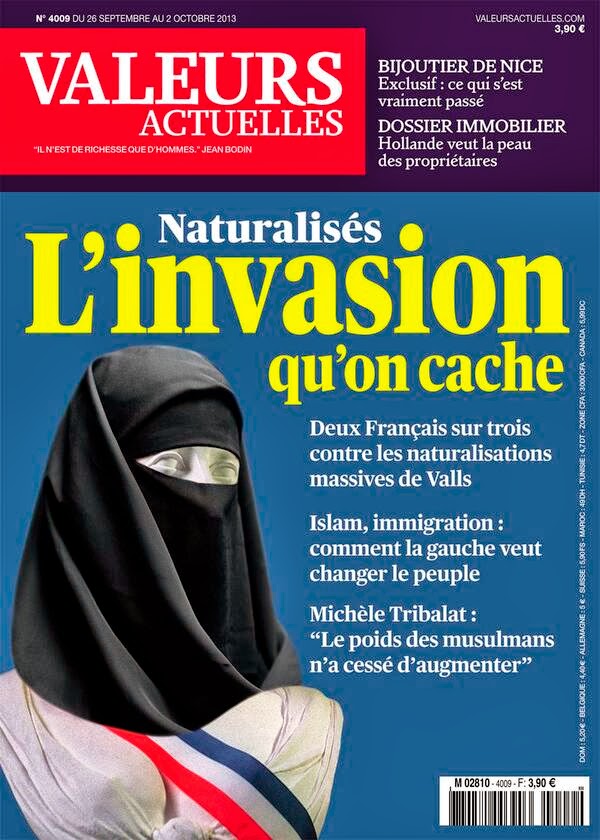
The Union of Jewish Students of France is suing the editor of Valeurs Actuelles for inciting racist hatred. Le Monde says 'Shocked by the hateful cover of the weekly Valeurs Actuelles' the Union of Jewish Students of France (UEJF) announced on Wednesday 25 September its intention to sue Yves de Kerdrel, director of the publication for inciting racist hatred.


The cover of the weekly that appeared on 26 September featured the picture of a Marianne (symbolising the French Republic) wearing a face veil next to the alarmist title 'The naturalised: The invasion they hide'. The title utilises a common spatial metaphor that gives the abstract phenomenon of migration - an essentially unplanned and decentered process characterised by disjuncture - the characteristics of an intentional, planned and, at the end of the day, malicious effort to undermine the sovereignty of
the French Republic (see also Sofos and Tsagarousianou, Islam in Europe, chapter 1).

Although the articles are primarily Islamophobic, the Union of Jewish Students of France considered that islamophobia, antisemitism and, more generally, racism are not that distinct ideologies and practices and therefore decided to move against the journal. 


Saturday, 15 June 2013

Graduating Students Claim MA Diversity and the Media Broadens Their World

Originally published in http://www.media-diversity.org

Students who attended the course this year are still savouring and digesting all the thought-provoking knowledge they were nourished with. They come from different countries, speak different languages, they have different cultural backgrounds and make plans for different careers. Yet, they share the same impressions about the MA in Diversity and the Media at the University of Westminster. They claim the course has widened their horizons. “I used to consider myself an open-minded person, but I realised I wasn’t,” says Betina de Tella, 26-year-old student from Brazil. Khaled Abdalla, from Egypt, is of the same opinion: “This master changed my view about everything happening around me. I now pay attention to things I never thought about before.”
The MA Diversity and the Media, designed and developed in collaboration with the Media Diversity Institute in 2010, is a highly innovative course. It is designed to attract not only media graduates, but also “people who have already worked in journalism, but want to enhance their skills in the area of inclusive journalism,” the course guideline says. When asked if she would recommend it, Thaila Moreira, from Brazil, has no doubts: “I always tell my friends they’re missing a huge part of the world, because the world is not just surface. The approach you are taught during lectures helps you to see different issues you couldn’t normally see,” she continues. Learn how to be a good journalist But what is it that makes this MA studies at Westminster University unique? Ivana Jelača, 25-year-old student from Serbia, has the answer: “Most of the media courses teach you how to sell the story. The MA Diversity and the Media provides you with skills and critical abilities that can make a difference,” says Jelača. The Diversity and the Media course encourages student journalists to look at, reflect, and report on the society they live in. At the end of the year, they have developed a critical understanding of the role of mass media in the social construction, representation and understanding of difference and social diversity. Shazwan M. Kamal, a student who has worked in Malaysia as a reporter, explains: “There is not enough understanding in the media about diversity. Journalists should think about repercussions, but they don’t.” Theoretical engagement is not the only focus of the Master. Theories are combined with practice-oriented modules intended to give first-hand experience in the practice of inclusive journalism. “We learned how sociology can help you understand the media,” explains Lin Zhao, a young student from China, “but it is a practical learning at the same time”. As the website course overview explains, through the practical training students are equipped to enter employment in various areas of the media, or communication with governments and NGOs focusing on immigration, equality, and social inclusion. Hebatallah Katoon, 25, came to attend this course from Egypt, where she works as a university teacher. Having produced a documentary on the life of dwarves in Egypt and being involved in charity projects with disabled people, she is not the kind of person you would consider to be unaware of the importance of diversity.  Yet, her studies at Westminster were useful for her, too. “This course gave me the tools to deal with today’s challenges,” she says. “I now know how to make my students appreciate diversity”. Still, books and lectures are not the only way students have learnt to appreciate diversity as a value. One of the distinctive features of the course is the diverse cultural backgrounds of students. “Having classmates coming from all over the world has definitely enriched my experience,” comments Betina de Tella. “We have had great debates.” In addition, London itself offers them the opportunity to be part of a society where a multitude of different ethnic groups live together. In a few months students will be flying back to their home countries where they will apply in both profession and life what they learned throughout the academic year. A lot of work is waiting for them, but they are ready to respond to the challenges.

Wednesday, 22 February 2012

Social Diversity and the Arab Spring: Egypt a year after


Reflecting about the passing of a year since Egypt’s popular uprising that eventually led to the end of the rule of the Mubarak political dynasty one can read signs that are typical of the trajectory of the Arab Spring throughout the Middle East and North Africa. It is commonplace to say that the loosening of Mubarak’s hold to power has been largely symbolic as the military and several forces inextricably linked to the ancien régime continue to dominate the political system of the country. True, voices that had only no or limited political expression before January 2011 have been propelled to the political arena: The Muslim Brotherhood is gently flexing its newly found political muscles as is the new Salafist Party. Other secular and liberal forces have also found expression in a polyphonic and complex political arena.
However, the expression of the considerable social and cultural diversity of this complex society has brought with it numerous challenges. The Islamic political forces are treading carefully when it comes to issues such as women’s rights but, still, have often articulated their social conservatism within a discourse of women’s rights. “Empowering” women in this context is often construed by party cadres and activists as “liberating” women from “alien” habits and compulsions. This is becoming visible in the domestic sphere as recent debates on female circumcision indicate.
Another area that has been affected by the transition relates to the relations between Egypt’s majority Sunni Muslim community and its sizeable Coptic Christian minority. Already in the early days of the uprising, the regime saw in intercommunal conflict  a potent destabilizing factor. Although many commentators hurried to dismiss the tensions, the fact remains that the coexistence between the two communities has always been premised on fine and precarious balancing. As new social and political forces will strive for popular support they are likely to turn “difference” into “antagonism” and diversity into threat.     
Another challenge that will increasingly need addressing is the urgent need to integrate an increasingly vocipherous younger generation into the political system and the economic fabric of the country. Affected by both disenfranchisement and chronic unemployment, Egypt’s youth has been at the forefront of the country’s incomplete political transition and has invested a lot in change, a transformation of Egyptian society that has yet to come. From the barricades and the demonstrations to the realm of the social media, this highly diverse demographic group is increasingly gaining a voice and expressing its frustration. What is also interesting is that the visions of a new Egypt and the voice of this new generation of citizens have been largely articulated and taken shape through the use of the new media.
Despite socioeconomic disparities young people of diverse backgrounds have proved literate in the use of new media: the majority resorted to cellular phones while many used very effectively social media such as Facebook, Twitter, YouTube, blogs against a disproportionately advantaged political class and the state apparatuses. Similarly, in addition to its impressive internet presence of old, there are indications that the Muslim Brotherhood is getting very adept in harnessing the networking potential of the new media to mobilise its own supporters.
Without underestimating the older, infotainment-oriented media, it is clear that political mobilization and the expression of social diversity in Egypt, is conducted and will be so, in public spaces partly shaped by the new media.