Showing posts with label Islam. Show all posts

Thursday, 24 October 2013

Britain's niqab debate: Channel 4


The debate about the face veil is not a novel one. Muslim notions of modesty, have often been subverted and colonized by patriarchal practices seeking to restrict women's autonomy. As such, the veil issue has mobilized social forces inspired by liberalism and western feminism and generated valuable criticisms of patriarchy in Muslim communities. On the other hand, Muslim women in Europe (but also in parts of the Middle East, North Africa and Asia where secularist forces have been able to inform or determine state policy) who choose or are forced to cover their bodies and faces are often subjected to state regulation and disciplining. Focusing on Europe, it is undeniable that the 'out of place' look of veiled women in public spaces all over the continent has provided fertile ground for the transformation of the veil issue into a potent mobilizing symbol for xenophobic, right wing forces only too happy to jump into the bandwagon of the secular, liberal and feminist opposition to the veil and, often, to incorporate these discourses into their own arguments. 

We have discussed here how the dignity of Muslim women has, predictably, become the rallying point of the European Right as it provides a respectable vehicle through which it can deploy its xenophobic discourse. Shockingly this obsession with the way Muslim women dress has not been confined to Europe's populist Right; it has been taken up by forces of the broader Left which have been at the forefront of struggles for human, political and social rights. In the burqa ban vote at the French National Assembly not one single voice was raised to doubt, let alone protest at, the institutionalization of the violation of several fundamental rights of Muslim women through the regulation of how they can dress in public.
A veiled woman next to the minarets
both potent symbols of the 'islamization'
of Switzerland in the recent minaret referendum 

As we have argued 
in the UK the niqab, has been posited in public discourse as the visible symbol of the perceived lack of integration of the Muslim community into British society and has therefore been associated with the whole debate over the perceived failures of multiculturalism as Jack Straw’s (who was at the time leader of the House of Commons) 6 October 2006 column in the Lancashire Telegraph indicated when he described the veil as "such a visible statement of separation and of difference". 
In most interventions of this sort, proponents of the ban use arguments that identify in the veil patriarchal oppressive practices that are detrimental to the dignity of Muslim women, or safety and security problems or, finally, barriers to intercultural communication and social cohesion. Without disputing that there are Muslim women who are coerced into, or feel they have no choice but to cover up, I believe that it is arrogant and dangerous to assume or suggest that the face veil is taken up by Muslim women in Europe just because of social pressure from within their communities or as a result of more material forms of coercion (French legislation for example has inbuilt in it a 'cherchez l'homme' clause as it provides for enormous fines for the men who force women to cover).

What is remarkable however, and should be noted, is that this debate is also one conducted over the absence of the women in question, as it largely leaves the affected women in a position of aporia, voiceless and powerless in the midst of a cacophony of opinions offered by western politicians, human rights activists and feminists on the one hand, and Muslim community leaders on the other: veiled women constitute the battlefield between abstract discourses of emancipation and discourses of cultural autonomy that emphasize the lack of competence of the part of liberals and feminists to criticize an essentially reified 'muslim' culture and tradition. It is true, that behind the veil one can find women that are isolated, lonely, abused and oppressed. In such cases, the veil can dissimulate suffering and silence cries for help. In such cases we need to devise ways of listening, of intervening and of empowering. On the other hand, considering the veil simply as a means and symbol of oppression may be misguided as it decouples it from its social-historical context. In the course of our research we have encountered numerous young women who experiment with covering their hair or face who have stressed in very articulate ways that this was a matter of choice and not coercion. Women have mentioned numerous reasons for covering or veiling themselves: affirming their identities as young Muslims, protesting against assimilationist ideologies and practices, expressing their religiosity and protecting themselves from the objectification of the male predatory gaze.

Before resorting to the platitudes that are rehearsed time and again in order to bring about a blanket ban on the niqab, it is worth considering the voices of women who stress the right to choose as the primary reason for wearing it. The Channel 4 debate goes some way towards this direction as guests in the debate include advocates of banning the veil (Douglas Murray), moderates who try to argue that the veil is not universally accepted among Muslims (Yasmin Alibhai-Brown) and veiled women (Fatima Barkatullah, Sahar Al-Faifi, Shalina Litt). Having watched the debate, we were left with the feeling that the debate format, however useful, may make a disservice to the complexity of the issue. The binary logic that permeates the discussion has helped reify two opposing positions advocated by selected guests who have the necessary symbolic capital to frame the debate along these lines. As one of our Muslim friends has suggested, after watching the debate she was left with mixing feelings. She felt that ordinary Muslim women who do not quite fit into the 'boxes' the debate participants had constructed were left voiceless.

We will soon start to address this issue ...

Friday, 27 September 2013

United we stand

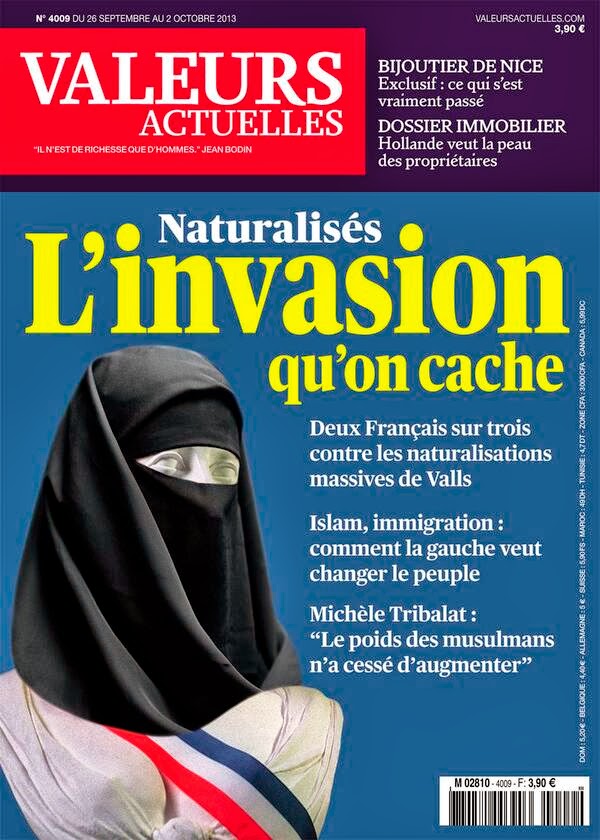
The Union of Jewish Students of France is suing the editor of Valeurs Actuelles for inciting racist hatred. Le Monde says 'Shocked by the hateful cover of the weekly Valeurs Actuelles' the Union of Jewish Students of France (UEJF) announced on Wednesday 25 September its intention to sue Yves de Kerdrel, director of the publication for inciting racist hatred.


The cover of the weekly that appeared on 26 September featured the picture of a Marianne (symbolising the French Republic) wearing a face veil next to the alarmist title 'The naturalised: The invasion they hide'. The title utilises a common spatial metaphor that gives the abstract phenomenon of migration - an essentially unplanned and decentered process characterised by disjuncture - the characteristics of an intentional, planned and, at the end of the day, malicious effort to undermine the sovereignty of
the French Republic (see also Sofos and Tsagarousianou, Islam in Europe, chapter 1).

Although the articles are primarily Islamophobic, the Union of Jewish Students of France considered that islamophobia, antisemitism and, more generally, racism are not that distinct ideologies and practices and therefore decided to move against the journal. 


Wednesday, 27 July 2011

Anders Behring Breivik had no legitimate grievance


Anders Behring Breivik had no legitimate grievance

Politicians should not use the Norway attacks to drag the idea of multicultural failure into mainstream acceptability
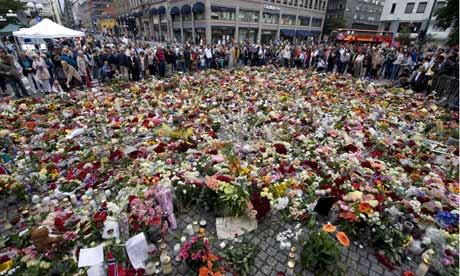
norway memorial oslo
Anders Behring Breivik's victims are remembered at a makeshift memorial outside the Domkirken church in Oslo. Photograph: Jonathan Nackstrand/AFP/Getty Images
Despite the fact that Anders Behring Breivik was not permitted to publicly justify his actions in public on Monday, a scrambling defence of his repertoire of prejudice is already in full swing. Writing in the Wall Street Journal, Bruce Bawer, who is quoted by Breivik in his manifesto 2083: A European Declaration of Independence, emphasises his repeated warnings that a rightwing extremist may use violence to address "legitimate concerns about genuine problems". Bawer blames mainstream politics for failing to address the corrosion of Europe by Islamicisation and multiculturalism, meanwhile The Jerusalem Postcautions that "Oslo's devastating tragedy should not be allowed to be manipulated by those who would cover up the abject failure of multiculturalism".
Racism is often justified as an aberrant reaction to understandable provocation; the focus on "multiculturalism" in the aftermath of the Oslo tragedy draws attention to contemporary racism's most elastic alibi. The "failure of multiculturalism" is an article of faith in European politics and, like all acts of faith, it depends on the acceptance of an underlying mystery. Despite the denunciations of this "failed experiment", there has never been a time in Europe where multiculturalism was the dominant ideology. As Ralph Grillo has argued, state practices, in the few countries that have adopted them, are characterised by a "weak" patchwork of policy initiatives and aspirational rhetoric. Yet critics have consistently assumed the damaging existence of a coherent "strong" form, which is always "unbridled".
Multiculturalism has historically been accompanied by accusations of "reverse racism" and "unfairness to whites". Since 9/11, politicians and commentators have held it responsible for an extraordinary range of social and political problems. The overwhelming power attributed to this semi-fictional project, and the fact that it is often critcised in countries with small immigrant populations, with no real history of multiculturalism in practice, should give pause for thought.
It is widely recognised that racism underwent a change in the post-war period, shifting from being an ideology of racial hierarchy to one of "natural" cultural incompatability. The so-called "new racism" of far-right parties during the 1980s and 1990s ingested the language and logic of multiculturalism, and portrayed ordinary – white – people as victims of an elite imposition, hypocritically denied their "right to culture". These ideas are pressed into service in the emerging defence of Breivik's political despair. In extreme versions, multiculturalism is regarded as self-hatred, in more nuanced attacks as a laudable experiment that foundered on the rocks of their difference and "our" naive generosity. Both versions portray "multiculturalists" and "immigrants" as an internal threat to a given national culture, and an otherwise pristine state of social cohesion.
The vision of multiculturalism as a conspiratorial alliance between varieties of leftists and "Islamists" is a staple of the Islamophobic blogosphere. In his analysis of Breivik's document, Doug Sanders points to the influence of "Eurabian" writers such as Bawer, Mark Steyn, Melanie Phillips and Robert Spencer in agitating for a millenarian vision of a civilisation under attack. This début-de-siècle genre mirrors the fin-de-siècle European obsession with decadence and moral decay, the difference being that it is now Muslims, rather than Jews, that threaten to devour their tolerant hosts.
What makes the narrative of multicultural failure toxic, however, is its mainstream acceptability. There is no cordon sanitaire between the out-and-out Islamophobes and the political mainstream, and the past decade has proved that the traffic of ideas goes both ways. The myth of excessive generosity allows for tighter migration regimes, compulsory integration projects and neo-nationalist politics to be presented as nothing more than rehabilitation.
Recent recitations of the comforting narrative by the German chancellor, Angela Merkel, and Britain's prime minister, David Cameron, garnered significant publicity. More attention needs to be paid to the mainstream racism it has given legitimacy to elsewhere in Europe. The former Dutch immigration minister Rita Verdonk proposed a system of "integration badges" for immigrants. The former Danish prime minister Anders Fogh Rasmussen declared a "battle of culture" against multiculturalism and Islam, and his culture minister, Brian Mikkelsen, explicitly targeted a "medieval Muslim culture" in Denmark. Päivi Räsänen, the new Finnish interior minister, proposed prioritising Christian refugees in the interests of cohesion and to "prevent discrimination". While these examples are drawn from contexts now associated with far-right electoral successes, they illustrate how the alibi of an "utterly failed" multiculturalism has provided political capital to centrists and liberals for quite some time.
The political class should reflect before responding to the tragedy in Norway, particularly when "austerity" politics may make the scapegoating of immigrant-descended and Muslim groups worse. No easy connections can be made between the recorded thoughts of a killer and the complex circulation of political ideas. However, writers who have consistently warned of the need to defend an ailing civilisation have questions to answer when a massacre is explicitly justified in their terms. And mainstream politicians, content to lazily peddle an exaggerated story of multicultural excess and Muslim difference are not exempt from this criticism.