Originally published in
http://www.media-diversity.org
Students who attended the course this year are still savouring and digesting all the thought-provoking knowledge they were nourished with. They come from different countries, speak different languages, they have different cultural backgrounds and make plans for different careers. Yet, they share the same impressions about the MA in Diversity and the Media at the University of Westminster. They claim the course has widened their horizons. “I used to consider myself an open-minded person, but I realised I wasn’t,” says Betina de Tella, 26-year-old student from Brazil. Khaled Abdalla, from Egypt, is of the same opinion: “This master changed my view about everything happening around me. I now pay attention to things I never thought about before.”

The MA Diversity and the Media, designed and developed in collaboration with the Media Diversity Institute in 2010, is a highly innovative course. It is designed to attract not only media graduates, but also “people who have already worked in journalism, but want to enhance their skills in the area of inclusive journalism,” the course guideline says. When asked if she would recommend it, Thaila Moreira, from Brazil, has no doubts: “I always tell my friends they’re missing a huge part of the world, because the world is not just surface. The approach you are taught during lectures helps you to see different issues you couldn’t normally see,” she continues. Learn how to be a good journalist But what is it that makes this MA studies at Westminster University unique? Ivana Jelača, 25-year-old student from Serbia, has the answer: “Most of the media courses teach you how to sell the story. The MA Diversity and the Media provides you with skills and critical abilities that can make a difference,” says Jelača. The Diversity and the Media course encourages student journalists to look at, reflect, and report on the society they live in. At the end of the year, they have developed a critical understanding of the role of mass media in the social construction, representation and understanding of difference and social diversity. Shazwan M. Kamal, a student who has worked in Malaysia as a reporter, explains: “There is not enough understanding in the media about diversity. Journalists should think about repercussions, but they don’t.” Theoretical engagement is not the only focus of the Master. Theories are combined with practice-oriented modules intended to give first-hand experience in the practice of inclusive journalism. “We learned how sociology can help you understand the media,” explains Lin Zhao, a young student from China, “but it is a practical learning at the same time”. As the website course overview explains, through the practical training students are equipped to enter employment in various areas of the media, or communication with governments and NGOs focusing on immigration, equality, and social inclusion. Hebatallah Katoon, 25, came to attend this course from Egypt, where she works as a university teacher. Having produced a documentary on the life of dwarves in Egypt and being involved in charity projects with disabled people, she is not the kind of person you would consider to be unaware of the importance of diversity. Yet, her studies at Westminster were useful for her, too. “This course gave me the tools to deal with today’s challenges,” she says. “I now know how to make my students appreciate diversity”. Still, books and lectures are not the only way students have learnt to appreciate diversity as a value. One of the distinctive features of the course is the diverse cultural backgrounds of students. “Having classmates coming from all over the world has definitely enriched my experience,” comments Betina de Tella. “We have had great debates.” In addition, London itself offers them the opportunity to be part of a society where a multitude of different ethnic groups live together. In a few months students will be flying back to their home countries where they will apply in both profession and life what they learned throughout the academic year. A lot of work is waiting for them, but they are ready to respond to the challenges.
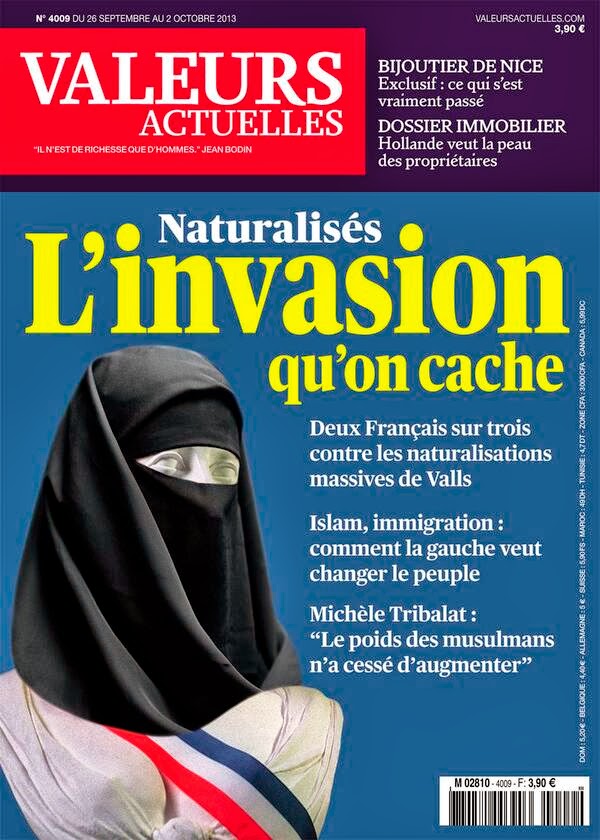 The Union of Jewish Students of France is suing the editor of Valeurs Actuelles for inciting racist hatred. Le Monde says 'Shocked by the hateful cover of the weekly Valeurs Actuelles' the Union of Jewish Students of France (UEJF) announced on Wednesday 25 September its intention to sue Yves de Kerdrel, director of the publication for inciting racist hatred.